
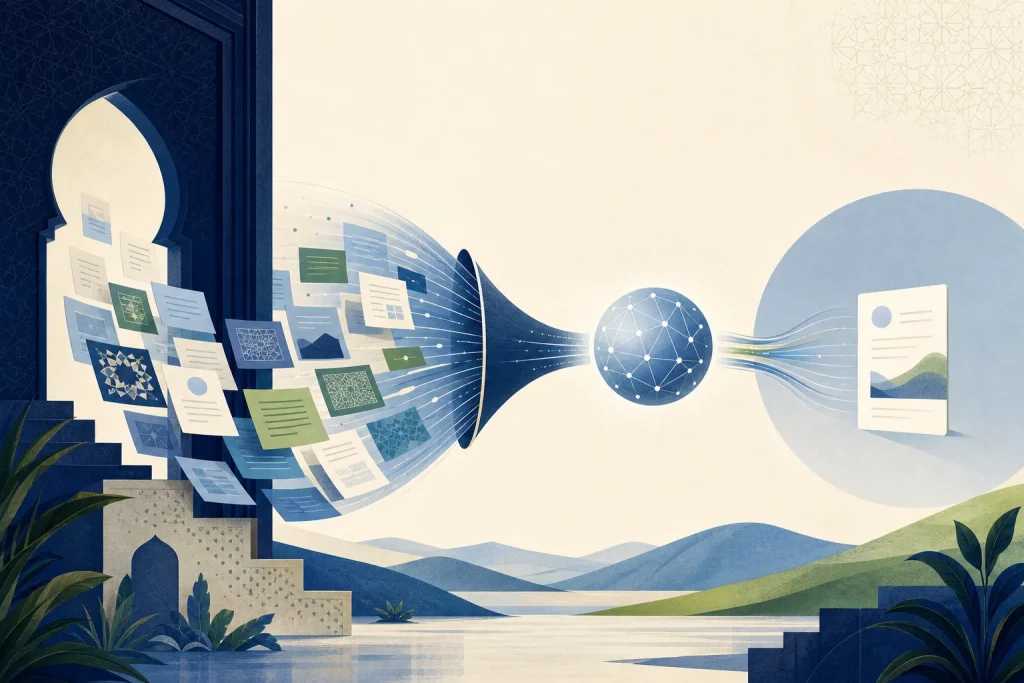
Retrieval-augmented generation (RAG) is a way to help a generative AI application answer questions using information retrieved from external sources. Instead of relying only on what a language model learned during training, the application searches an approved collection, supplies relevant material to the model, and asks it to produce an answer using that context.
For organizations, the appeal is practical: an assistant can draw on product documentation, support articles or internal procedures without retraining the model whenever those documents change. RAG can make answers easier to verify, but it does not guarantee that they are correct, current or secure.
How does RAG work?
The original RAG research paper combined a language model with retrieved knowledge. Modern implementations vary, but a typical document-based workflow has four stages:
- Prepare the sources. Select approved documents, extract their contents and divide longer material into manageable passages, often called chunks. Keep metadata such as source, version and access permissions.
- Make content searchable. Index the passages. Some systems create embeddings: numerical representations that help compare the meaning of a question with the meaning of a passage.
- Retrieve relevant evidence. When someone asks a question, the application searches the index and selects passages the user is authorized to access. Keyword search, vector similarity or a combination of both can be used.
- Generate an answer. The application sends the question and selected passages to a language model. The response can include links to the source material for the reader to check.
For example, an employee might ask which steps are required to escalate a customer issue. A RAG assistant could retrieve the relevant sections of an approved support manual and summarize them with links. This is an illustrative use case, not a guarantee that every answer will be complete.
Microsoft’s RAG design guide describes how decisions about chunking, retrieval and evaluation affect a solution. A vector database is one possible component, not a requirement for every RAG design.
When is RAG a good fit?
RAG is worth considering when users repeatedly need answers from a sizable collection of documents that changes over time. Potential applications include internal knowledge assistants, product-support search and tools that help teams navigate technical documentation.
The approach is less compelling when a small, stable document can simply be searched, when exact database queries or calculations are needed, or when the underlying content is unreliable. A conventional search interface, a rules-based workflow or a direct connection to a structured data system may be a better starting point.
RAG versus fine-tuning
RAG supplies external information at answer time; it does not ordinarily change the model’s trained weights. Fine-tuning changes a model through additional training and may be useful for adapting behavior or output style. The two approaches can be combined, but fine-tuning alone is not a substitute for a well-maintained source of changing facts.
What are the limitations and security risks?
- Incorrect or missing evidence: Search can retrieve the wrong passage or miss an important exception. The model can also misinterpret sound evidence or cite a source that does not support its claim.
- Stale content: An answer is only as current as the indexed material and the process that updates or removes it. Set refresh expectations and designate document owners.
- Unauthorized disclosure: Enforce source-level permissions during retrieval and test that users cannot receive passages they are not entitled to see. Consider where documents, prompts and logs are stored or processed.
- Prompt injection: A retrieved document can contain instructions intended to manipulate the assistant. Treat retrieved text as untrusted data, limit the application’s privileges and test defenses; no single filter guarantees protection.
The OWASP RAG Security Cheat Sheet outlines controls across ingestion, retrieval and generation. For decisions with serious consequences, retain human review: the NIST generative AI profile identifies confidently presented false content as a risk of generative AI.
How to evaluate a RAG project
Begin with one workflow, a defined user group and a controlled set of sources. Before expanding, compare the proposed assistant with the existing process:
- Build a representative test set. Include common questions, ambiguous requests, missing answers and questions in the languages users actually need. Record the expected sources and answers with domain experts.
- Measure retrieval and answers separately. Check whether relevant authorized passages are found, whether answers are supported by those passages, and whether citations point to the right evidence. Test refusals or uncertainty when evidence is absent.
- Test operations and security. Check permission changes, document updates, malicious content and response times. Decide who monitors failures and maintains the index.
- Compare costs and benefits. Account for document preparation, indexing, search, model use, hosting, evaluation and ongoing support. Measure outcomes relevant to the workflow, such as time to locate information and the rate of answers requiring correction.
Acceptance thresholds should reflect the risk and be agreed before a pilot. A good demonstration is not evidence that the system will perform equally well across every document, language or user group.
Delivery and partnership choices
Managed services can simplify parts of ingestion, search and model access; a more customized stack can offer different degrees of control and integration. Compare options against data location, permission handling, operating cost, latency and the team’s ability to maintain them. Ownership of source content, evaluation results, incident response and handover should be clear in any delivery agreement.
Altweeb’s software development, technology consulting and AI automation services provide a relevant starting point for discussing these choices. An initial conversation should establish the business problem, available data and responsibilities before committing to a particular architecture.
Conclusion
RAG connects generated answers to retrievable information, making it useful for knowledge-intensive workflows. Its value depends on the quality of the sources, access controls and ongoing evaluation—not on the presence of a chatbot alone.
To explore this further, see AI Automation for Business Optimization.




Add your perspective