
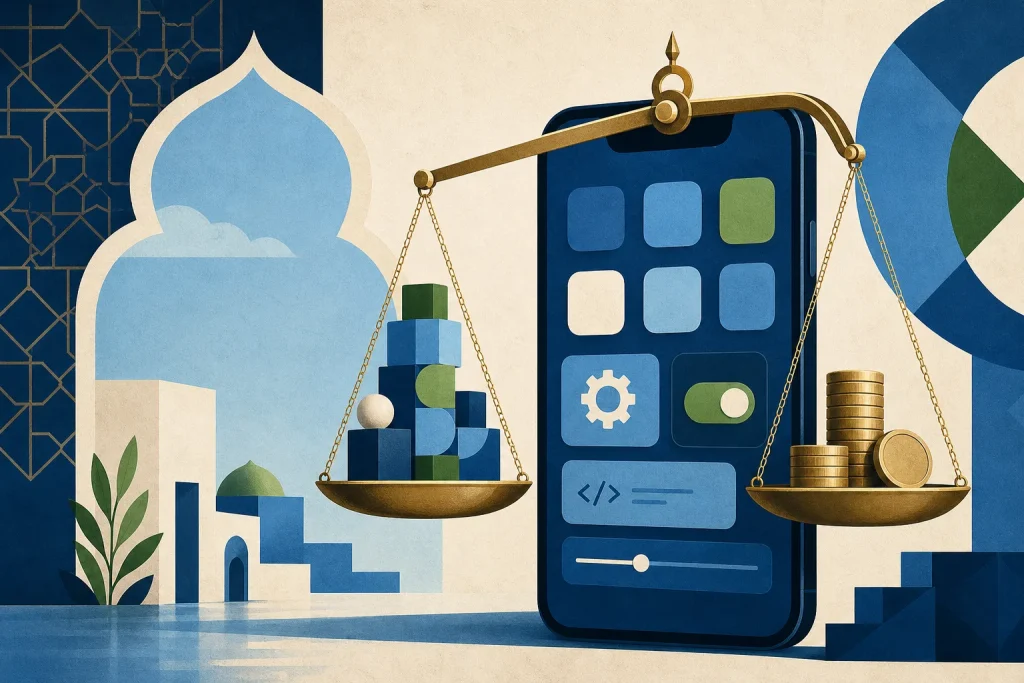
Mobile app development can cost from tens of thousands of dollars to several hundred thousand, depending on what the product must do and how it is delivered. A useful budget separates the initial build from the costs of running and improving the app after launch.
For a starting point, Clutch’s 2026 pricing guide says most app development projects reviewed on its platform fall between $10,000 and $49,999. Its reported average is approximately $90,780. These figures describe projects in Clutch’s review dataset, not a universal price or an Altweeb quote.
Mobile app cost benchmarks by complexity
GoodFirms’ 2026 research combines input from 267 development companies with published industry benchmarks. It offers these broad estimates:
- Basic app: $15,000–$40,000. For example, a straightforward interface with login, profiles and limited backend functionality.
- Mid-level app: $40,000–$120,000. The research associates this tier with features such as payments, external integrations and reporting.
- Advanced app: $100,000–$250,000+. Multiple user roles, real-time communication or offline synchronization can add complexity.
- Enterprise-level app: $250,000–$500,000+. Larger systems may require multiple platforms, enterprise integrations and more demanding security and operational work.
The ranges overlap because complexity is not a precise category. GoodFirms and Clutch use different sources and methods, so their figures should be treated as context rather than directly comparable quotes. Actual prices vary with geography, team composition, existing systems and scope.
What drives the price?
- Features and workflows: A booking flow is more than a screen; it may involve availability rules, confirmations, cancellations and administration.
- Platforms: Building for iOS and Android increases the work to test and release. A shared cross-platform codebase may reduce duplication, but platform-specific development and testing can still be necessary.
- Backend and integrations: Accounts, databases, dashboards and connections to payment or business systems all need to be specified. Existing systems are not necessarily ready to integrate.
- Design and accessibility: Research, prototypes, language variants and accessible interactions require time, but can reduce the risk of building the wrong experience.
- Security and testing: Budget for device testing and safeguards appropriate to the data involved. The OWASP Mobile Application Security Verification Standard is a useful reference for areas including authentication, storage and network communications; backend security also needs separate consideration.
A sample build budget
Suppose a buyer plans a cross-platform booking app with login, a simple administrative interface and one existing service integration. The following is an illustrative calculation, not a market quote. It assumes a blended rate of $60 per hour for all listed work:
- Discovery and requirements: 80 hours
- Design and prototyping: 120 hours
- Mobile development: 300 hours
- Backend and integration: 160 hours
- Testing: 100 hours
- Release preparation: 40 hours
That is 800 hours × $60 = $48,000. Adding a hypothetical 15% contingency for uncertainty gives a planning allowance of $55,200. The hours, rate and contingency are assumptions: a real estimate should explain them and be revised after discovery. This example excludes taxes, store fees, third-party services, marketing and post-launch support.
Plan for costs after launch
Operating expenses can include hosting, monitoring, backups, customer support, security fixes, operating-system updates and new features. Usage-based services can change as traffic grows; for example, Firebase’s Cloud Functions documentation explains that usage above its no-cost allowances is billed on its pay-as-you-go plan.
For public distribution, the Apple Developer Program lists a $99 annual fee, while Google Play Console lists a one-time $25 registration fee. Regional pricing, taxes, eligibility and other terms can affect the amount paid. Depending on the business model and market, transaction or store commissions may also apply.
How to compare proposals
Ask potential delivery partners to estimate against the same brief: target users, platforms, essential workflows, integrations, security needs and success measures. Then compare:
- Deliverables, assumptions, exclusions and acceptance criteria—not just the headline price.
- Whether discovery, design, backend work, testing and store submission are included.
- Fixed-price terms for a defined scope versus time-and-materials billing for evolving requirements, including how changes are approved.
- Ownership and handover of source code, documentation, cloud and store accounts, and third-party licences.
- Warranty, support responsibilities, response expectations and a separate operating budget.
A staged release can help protect the budget: launch the smallest useful set of workflows, measure adoption and prioritize the next investment using evidence. Partners and investors should also examine who will operate the product and what it will cost to reach and retain users.
Conclusion
Benchmarks help set expectations, but a credible app budget comes from a defined scope and a plan for the full product lifecycle. Altweeb’s software development, technology consulting and team augmentation services provide relevant starting points for discussing delivery needs and partnership options.
To explore this further, see Software & Digital Product Development.
Sources and further reading
- Enrollment – Membership – Account – Help – Apple Developer
- Mobile App Pricing Guide 2026
- Get started with Play Console – Play Console Help
- OWASP MASVS – OWASP Mobile Application Security
- How Much Does It Cost to Develop an App in 2026? Full Development Cost Breakdown | Goodfirms Survey
- FAQ & Troubleshooting | Cloud Functions for Firebase




Add your perspective