
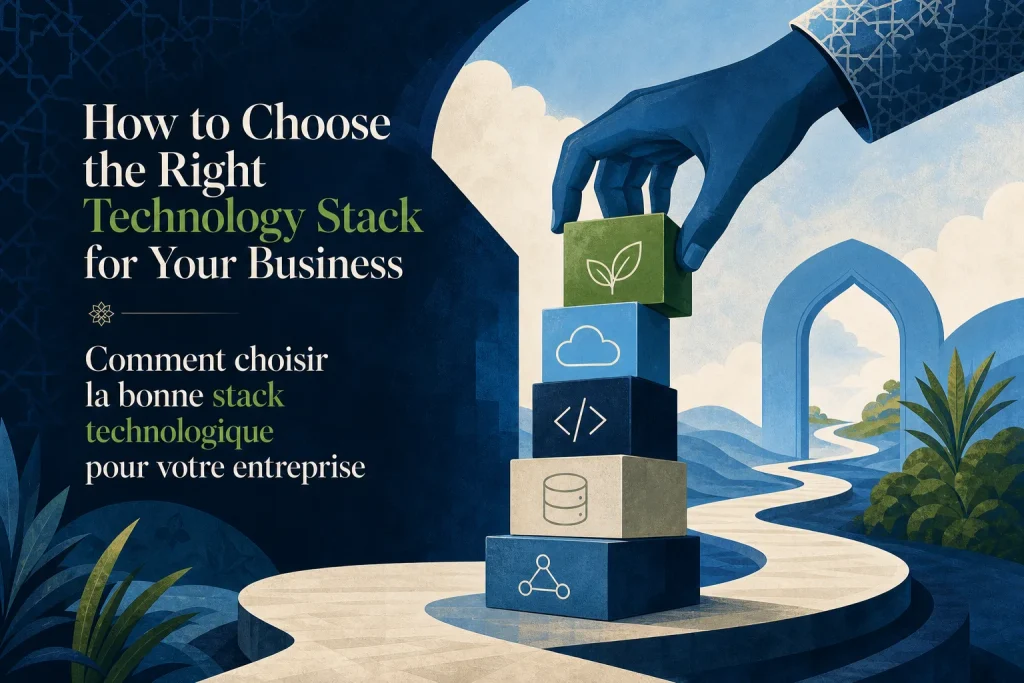
The right technology stack is not necessarily the newest or most popular one. It is the combination of tools your organization can use to deliver, operate and improve a product within its business constraints. A good choice makes trade-offs visible before they become expensive to reverse.
A stack typically includes the user interface, application code, data storage, infrastructure and tools for testing, deployment and monitoring. The following process helps buyers and delivery teams compare those layers without treating any one framework or language as the answer to every problem.
Start with requirements, not product names
Describe the outcomes the software must support: who will use it, which workflows matter, where users are located and which existing systems it must connect to. Separate launch requirements from plausible future needs.
Turn the most important constraints into checks. For example, define an acceptable response time for a key user journey, a recovery objective after an outage and any data-location requirements that have been established for the project. Identify who will maintain the system and what skills they have. Where requirements depend on contracts or regulations, have the relevant specialists establish them rather than assuming a tool makes the product compliant.
Compare the complete stack
- User interface and application layer: Consider accessibility, device needs, integrations, available libraries and how quickly the team can deliver and maintain features.
- Data layer: Match storage to data structure, transaction and reporting needs. Check backup, restoration, migration and export options.
- Infrastructure: Compare managed services with self-managed alternatives. Managed services can reduce some operational work, but evaluate their pricing, configuration limits and portability.
- Delivery and operations: Include automated testing, deployment, monitoring, incident response and the availability of people to run them.
AWS’s architecture selection guidance recommends considering cost and trade-offs and using benchmarks and data to inform decisions. Those principles are useful beyond a single cloud provider.
Choose architecture for the work, too
For a relatively focused product, a well-structured application deployed as one unit can be a practical starting point. Separate services may be justified when parts of a system genuinely need independent deployment or scaling and the team can manage the added operational work. Microsoft notes that microservices introduce challenges including inter-service communication, testing and data consistency; they are not a default upgrade for every product. See its guidance on microservices architecture.
Use a scorecard, then test the difficult assumptions
First eliminate options that cannot meet mandatory requirements. Then score the remaining candidates against weighted criteria. As an illustrative starting point, a team might assign 35% to product and integration fit, 25% to security and reliability, 20% to team and maintenance fit, and 20% to lifecycle cost. Score each category from one to five, multiply by its weight and compare the totals. Adjust the weights to the project; a high score must not override a failed mandatory requirement.
For example, a team building a customer portal could compare a JavaScript-based application with a Python-based alternative, both using a relational database. The better choice would depend on existing skills, integration requirements and the results of a small prototype—not the language alone. Test the hardest path first: connect to an existing system, exercise a representative workflow under expected load, and restore a backup. Record the test conditions, results and remaining unknowns.
Look beyond the launch budget
Estimate costs over an agreed planning period and document assumptions for low, expected and high usage. Include engineering, training, hosting, storage, data transfer, third-party services, support, security updates and migration or exit work. A lower initial build estimate can be offset by higher operating effort; the reverse is also possible. Review estimates as usage becomes clearer rather than presenting them as guaranteed prices.
Check dependency health and support arrangements, including release cadence, maintenance responsibility and end-of-support dates. Review component licences and obligations with appropriate specialists. The Open Source Initiative FAQ explains, for example, that some open-source licences impose source-code obligations in certain circumstances.
Make security and ownership part of the decision
Ask how each option supports access control, dependency updates, logging, testing and vulnerability response. The NIST Secure Software Development Framework offers a common set of practices that buyers and suppliers can use to discuss secure development. A framework or platform alone does not guarantee a secure product.
With a delivery partner, agree who owns the source repository, cloud accounts, data, deployment pipeline and documentation; who handles incidents and updates; and how handover will work. Test data export and identify provider-specific dependencies. Portability has a cost, so decide which components need an exit plan rather than demanding that every component be interchangeable.
Keep the decision in a short, dated record: requirements, options considered, evidence, costs, accepted risks and a trigger for review. Google Cloud’s architecture decision record guidance describes how recording alternatives and rationale helps teams understand and revisit choices.
How Altweeb fits into the discussion
Altweeb’s technology consulting and software development services are relevant when an organization needs to connect a stack decision to product delivery. Its IT staffing and team augmentation services are also relevant when a project needs additional team capacity. Buyers and potential partners should agree on scope, responsibilities, evidence and handover expectations for their specific engagement.
Conclusion
Choose the simplest stack that meets the non-negotiable requirements, fits the people who will operate it and has passed a proportionate test. Document the trade-offs and revisit the decision when the product, risks or operating assumptions materially change.
To explore this further, see Technology and digital growth, brought into one clear view..




Add your perspective