
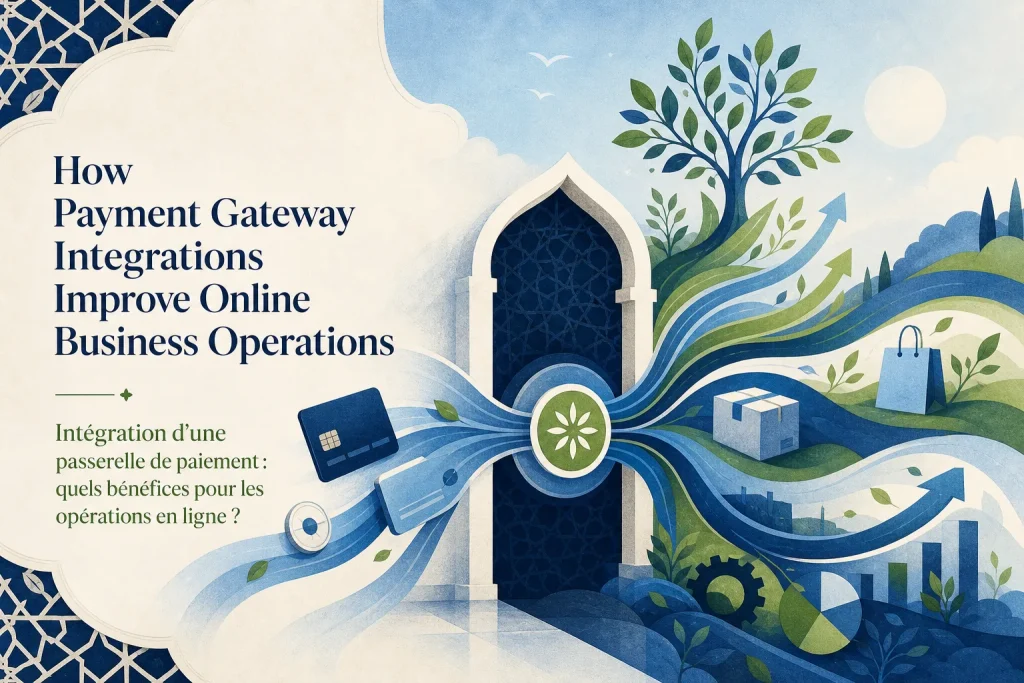
A successful online payment does more than complete a checkout. It creates information that order management, finance and customer support all need. When those systems are disconnected, teams may spend time checking payment statuses, correcting records and investigating refunds by hand.
Payment gateway integration connects a website or application to payment services and, where appropriate, to the systems that manage what happens next. The business value comes from designing the entire flow—not simply adding a payment button.
What a payment integration does
A gateway helps transmit payment information between the customer, the business and the payment provider. The wider integration also connects transaction updates to an order, invoice or subscription. Depending on the provider and payment method, a transaction may need customer authentication, remain pending, be captured later or subsequently be refunded or disputed.
For example, an online retailer can associate a payment reference with an order, update the order when the provider confirms the relevant status and use settlement reports to help finance match the resulting payout. That workflow needs clear rules for exceptions; it should not treat every checkout completion as money already received in the bank.
Where operations can improve
Checkout and market access
Offering suitable cards, wallets or bank-based methods can make checkout more convenient for different customers. However, availability depends on the merchant’s location, the customer’s market, currency, provider approval and the integration used. Adyen’s payment-method documentation illustrates how supported countries, currencies and features vary by method. Test the methods your actual customers need rather than assuming that a provider’s full catalogue is available to your business.
Order and subscription workflows
Payment notifications can update an order, trigger a receipt or inform a subscription system, reducing duplicate data entry. Some methods confirm payment asynchronously, so fulfillment rules must distinguish a pending payment from a successful one. Adyen’s integration checklist explicitly calls for handling pending statuses, refusals, refunds and other payment events.
Finance and customer support
Consistent references across orders, payment records and reports make it easier to investigate a customer query or match transactions to payouts. Settlement is not necessarily one payment per bank deposit: fees, refunds and other adjustments may affect the amount received. For example, Stripe describes a payout reconciliation report that links payouts to the transactions they settle. Finance teams should still review unmatched items and exceptions.
Choose the integration model deliberately
- Hosted checkout: Customers move to a provider-hosted payment page. This can reduce the amount of payment-page functionality the business builds, but offers less control over the experience.
- Embedded form or components: Provider-supplied payment elements appear within the business’s site or app. This can create a more continuous experience, while still requiring careful attention to the surrounding page and its scripts.
- More customized API flow: A tailored experience can accommodate more specific workflows, but generally requires more engineering, testing and ongoing maintenance. The security responsibilities depend on exactly how payment data is handled.
Providers may support several models; Stripe’s checkout documentation is one example. Compare them against your checkout requirements, accessibility, launch timeline, maintenance capacity and security responsibilities—not customization alone.
Build for reliability and security
Provider notifications, often called webhooks, are useful for updating back-office systems, but they need safeguards. Verify notification signatures, record processed events, handle duplicate or out-of-order delivery and monitor failures. Stripe’s webhook guidance covers these issues. For supported API operations, idempotency keys can also help make retries safer; they do not replace checking the transaction’s actual status.
Limit who can access payment administration, protect API credentials and avoid storing sensitive card data unless there is a justified need and the organization can meet the associated obligations. Outsourcing payment collection does not automatically remove all merchant responsibilities. The PCI Security Standards Council’s FAQ on script protection explains an eligibility criterion for certain embedded payment pages and advises merchants to check the appropriate assessment with their compliance-accepting entity. Requirements depend on the implementation; seek qualified security and compliance advice for your environment.
A practical implementation checklist
- Map the journey: Identify where customers pay, which systems need updates and who owns refunds, disputes and reconciliation.
- Compare providers: Verify merchant eligibility, target markets, payment and settlement currencies, payment methods, fees, payout timing, support and data-export options.
- Define states and controls: Decide which confirmed event authorizes fulfillment, how pending payments are reviewed and how exceptions are escalated. Store references that connect each order to its payment and payout records.
- Test beyond a successful payment: Include declines, authentication requests, delayed confirmation, duplicate notifications, refunds, provider outages and reconciliation mismatches. Agree on a manual fallback and rollback plan.
- Measure and improve: Establish a baseline, then track checkout completion, payment approval rates, time spent reconciling and the number and age of unresolved exceptions. Segment results by market and payment method, and investigate changes rather than assuming the integration caused them.
Working with a technology partner
Buyers should agree on the scope before development: provider selection, integration architecture, testing, documentation, handover and post-launch support. Clarify who owns the merchant account and credentials, who handles provider incidents, and how data can be exported if the business changes providers. Partners evaluating a joint delivery should also define responsibilities and escalation paths with the payment provider and the client.
Altweeb’s software development and technology consulting services provide a relevant context for organizations planning digital products and operational integrations. The right project scope depends on the business’s existing systems, chosen provider and delivery requirements.
Conclusion
A payment integration is most valuable when it connects a usable checkout with reliable transaction updates and workable finance processes. Start with the business workflow, choose an appropriate integration model and measure the operational results after launch.
To explore this further, see Digital products built around specific needs..




Add your perspective