
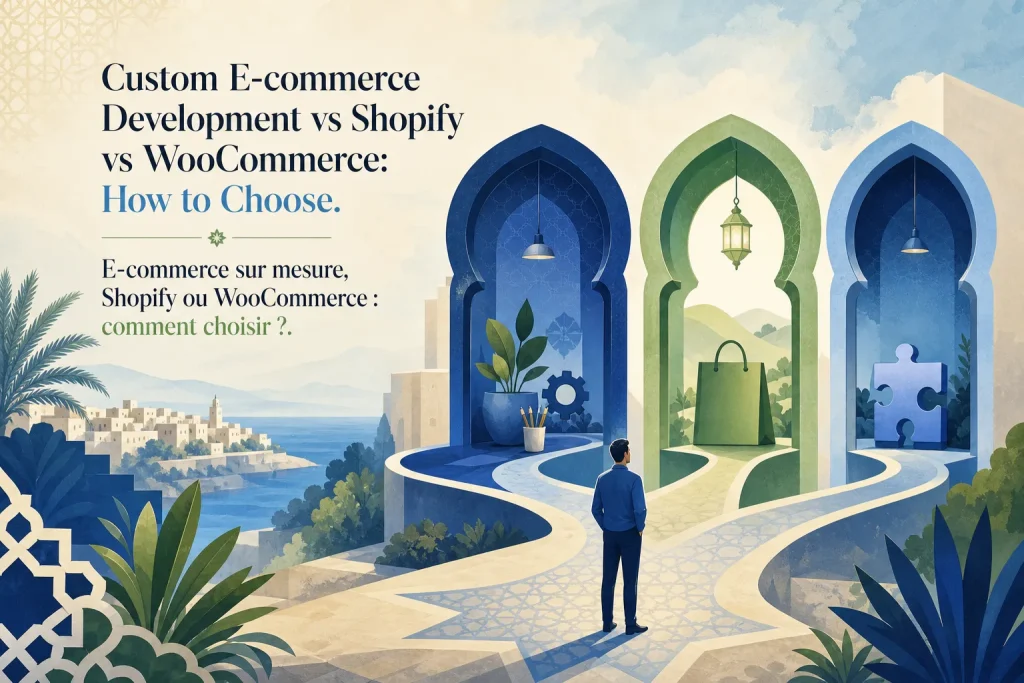
Choosing an e-commerce platform is less about finding the most powerful technology than deciding which capabilities your business needs to own, configure or buy. Shopify can reduce infrastructure work; WooCommerce offers an open-source foundation with more control over hosting; and a custom build gives a team more architectural choice in exchange for more delivery and maintenance responsibility.
Start with the customer journey and operational constraints, then compare the cost and risk of meeting them over time. A hybrid approach—using an existing platform with selected custom components—may be the most practical answer.
At a glance: which approach fits?
- Shopify: A good starting point when speed, managed infrastructure and standard commerce workflows matter more than unrestricted control. Check plan-specific limits and payment availability before committing.
- WooCommerce: Worth considering when WordPress content, hosting choice and extensibility are important, and someone can take responsibility for updates and the wider software stack.
- Custom development: Most compelling when a demonstrably important workflow cannot be met economically by a platform and its extensions, and the organization can sustain a product team or support arrangement.
These are starting points, not rules: a complex business can use Shopify or WooCommerce, while a custom solution can still rely on external payment, hosting and other services.
Shopify: managed infrastructure with platform boundaries
Shopify is a hosted commerce platform. It suits teams that want to focus on merchandising and operations rather than managing their own store infrastructure. Themes, apps and development can extend the experience, but each important requirement should be checked against the platform and the proposed plan.
For example, Shopify’s checkout UI extension documentation says extensions on the information, shipping and payment steps require Shopify Plus. That does not mean every checkout-related customization requires Plus: availability differs by extension and checkout stage. Test the specific workflow rather than assuming an app can change any part of checkout.
Payment economics also depend on the merchant’s location, eligibility and configuration. Shopify Payments is available only in supported countries and to eligible businesses. When a third-party provider is used, Shopify transaction fees may apply in addition to the provider’s processing fees; the fee rules and exceptions depend on the payment method and configuration.
WooCommerce: flexibility with a maintenance obligation
WooCommerce is an open-source commerce plugin for WordPress. It can be a strong fit for a content-led business or a team that wants to choose its hosting and extend its store. Developers can use existing extensions or build custom ones; WooCommerce recommends avoiding direct edits to core files when extending functionality. See its project structure and extension guidance.
The core plugin is only part of the budget. Hosting, paid extensions, development, security and maintenance can all contribute to the cost of running a WooCommerce store. More control also means assigning ownership for the stack: WooCommerce recommends backups and testing updates on a staging site before applying them to production. Its update guide also recommends checking critical flows such as checkout, payment and shipping.
Custom development: build where the difference matters
A custom commerce application can be justified when the business depends on workflows that are difficult to support within an existing platform—for example, unusual account-specific purchasing approvals, complex product configuration or integration with operational systems. First validate whether a platform extension or separate service could meet the same need with less ongoing complexity.
Custom does not have to mean building every component from scratch. A team might build a tailored storefront or pricing service while using established services for payments and other functions. The trade-off is that the organization must plan for architecture, testing, hosting, security, monitoring, upgrades and incident response. Greater control over code is not a guarantee of lower costs or easier migration.
Compare the full business case
Ask suppliers to estimate the same scope over a defined period, such as three years, and state their assumptions. Include:
- Delivery: discovery, design, configuration, custom code, integrations, testing and launch.
- Recurring costs: platform subscriptions, hosting, apps or extensions, support, monitoring and payment processing. Model transaction-related charges using expected order volume and payment methods.
- Change and risk: upgrades, security fixes, expected enhancements, incident response and the cost of replacing an unsupported app or integration.
- Exit: data export, migration work, access to source code where applicable, and any continuing dependency on a provider.
For a meaningful comparison, use the same scenarios for each option: normal trading, a seasonal traffic peak and entry into a new market. Make clear which figures are supplier quotes and which are internal assumptions. A lower launch estimate may not be the lowest-cost option once operating work is included.
Validate before you sign
- Rank requirements: Separate essential launch needs from future ideas. Identify the few workflows that would materially affect revenue, operations or customer experience.
- Test the difficult cases: Demonstrate an actual product configuration, order approval or integration—not just a standard demo. Record any plan, app or API dependency.
- Check each market: Confirm merchant eligibility, payment methods, currencies, shipping and tax workflows with the relevant providers for each selling market.
- Plan migration: Map products, customer records and order history; test a sample import; assign responsibility for redirects, cutover and reconciliation. Check whether payment tokens and subscriptions can move before promising uninterrupted renewals.
- Agree operating ownership: Document who handles updates, backups, access, monitoring, support response and recovery. Even when payment processing is outsourced, the PCI Security Standards Council says merchants retain responsibilities concerning their provider. Confirm applicable obligations with your payment partners.
Choosing a delivery partner
Whether working with an agency, an internal team or a technology partner, request a written scope, acceptance criteria, integration assumptions and a post-launch support plan. Clarify ownership of accounts, data and custom code, as well as access to documentation and the process for handing work to another team. For strategic partners or investors assessing a commerce initiative, these details help distinguish a repeatable operating model from a launch project that depends on undocumented knowledge.
Altweeb’s software development, technology consulting and team augmentation services can support organizations evaluating or delivering digital products. The appropriate engagement and technical approach should be defined around the project’s requirements rather than presumed in advance.
Conclusion
Choose Shopify when its managed model and boundaries fit, WooCommerce when open-source flexibility is worth the operational responsibility, and custom development when a critical need justifies owning more of the solution. In every case, validate the hardest workflow, the payment setup and the ongoing cost before choosing a platform.
To explore this further, see Digital products built around specific needs..



Add your perspective