
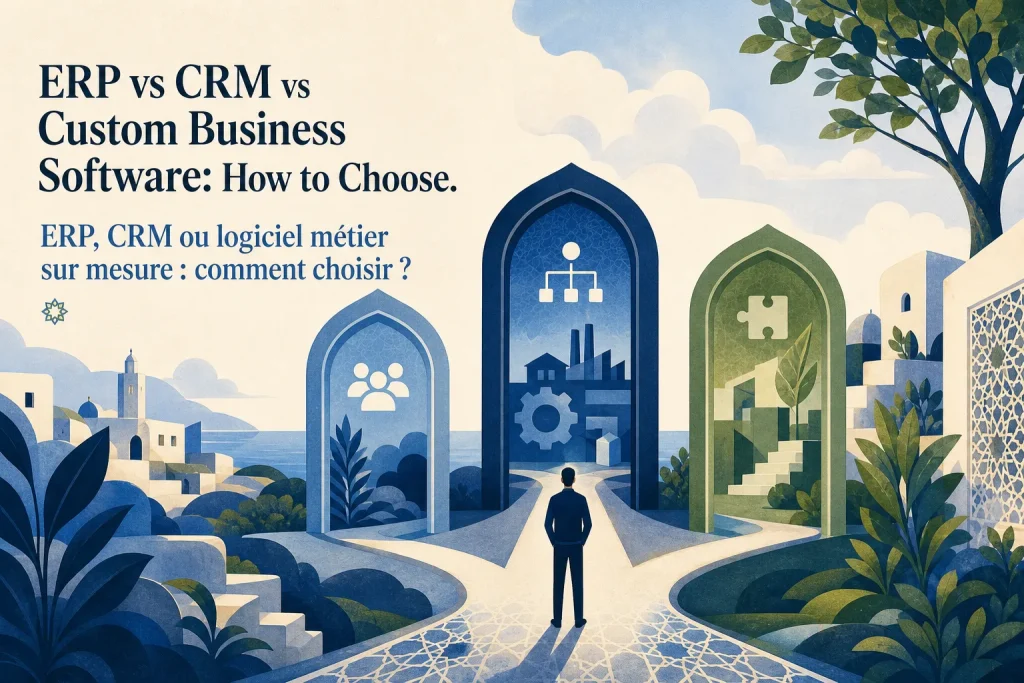
Choosing between ERP, CRM and custom software starts with a different question: which business process needs to work better? An ERP generally connects operational and financial processes; a CRM focuses on relationships with prospects and customers. Custom software is a delivery choice, not a third business function: it can support either area or connect them.
For many organizations, the decision is not all-or-nothing. A commercial product may cover common requirements, while a focused custom component handles a distinctive workflow. The right mix depends on process fit, integration, lifecycle cost and the team available to operate it.
What is the difference between ERP, CRM and custom software?
ERP: coordinate operations and finance
Enterprise resource planning (ERP) software connects processes such as accounting, purchasing, inventory and supply chain management. Available modules vary by product. ERP is worth investigating when teams struggle to reconcile operational and financial information across departments. Oracle’s comparison of ERP and CRM explains their different primary roles.
CRM: manage customer relationships
Customer relationship management (CRM) software helps teams organize prospect and customer information and track interactions. Depending on the product, it may support sales, marketing or service workflows. It is a useful starting point when the main problem is inconsistent lead follow-up, fragmented account information or poor visibility into customer requests.
Custom software: address a specific requirement
Custom business software is designed or adapted for an organization’s defined needs. It might be a partner portal, a specialized approval workflow or an integration layer. It offers control over requirements and design, but that control brings responsibility for ongoing support, security and change. A custom application can complement a commercial ERP or CRM rather than replace it.
These categories overlap: some suites include both operational and customer-facing features, and commercial products can often be configured or extended. Check the actual product and contract rather than assuming a feature is included.
Choose based on the problem, not the label
- Start with CRM if the priority is a shared view of leads, account activity or service follow-up, and operational systems already meet your needs.
- Investigate ERP if purchasing, inventory, finance or other core processes need coordinated data and controls.
- Consider custom development when a valuable workflow cannot be handled adequately through reasonable product configuration or existing tools.
- Consider a combination when several processes need different strengths—for example, a CRM for opportunities, an ERP for orders and finance, and a small custom portal for a specialized partner workflow.
These are starting points, not prescriptions. A smaller organization may not need an ERP suite, and an existing system may solve the problem after configuration or process changes. Before building, test whether the unusual requirement is genuinely necessary or simply a legacy habit.
Compare the full cost of each option
Use the same planning horizon for every proposal—three to five years, for example—and make assumptions explicit. Compare:
- One-time work: discovery, configuration or development, integration, data cleansing, migration, testing and training.
- Recurring work: subscriptions, hosting, support, upgrades, security, monitoring and internal staff time.
- Change and exit: expected enhancements, product or API changes, data export, transition assistance and the effort to replace a supplier.
For each option, add estimated one-time and recurring costs over the chosen period, then include the likely cost of change and exit. Compare this total with a baseline such as the current cost of manual re-entry or delays. Where benefits are uncertain, show a range rather than presenting a forecast as a fact. Commercial software is not automatically cheaper, and custom software is not automatically more expensive: scope, contracts and operating responsibilities matter.
Plan integration before signing
Imagine a distributor that uses a CRM to manage opportunities and an ERP to fulfill orders. A salesperson wins a deal, and the order must reach operations without creating duplicate customer records. Agree which system is authoritative for each field—for example, the CRM for sales contacts and the ERP for invoice status—rather than assuming one system owns every customer attribute.
Document what moves, in which direction, how frequently and what happens when an update fails. Check API access, usage limits, authentication, data mapping and whether a retry could create duplicates. Assign someone to monitor failures and reconcile records. Microsoft’s integration guidance highlights volume, frequency, direction and system capability as design considerations.
Evaluate suppliers and delivery partners
- Map a real workflow. Ask users from sales, operations, finance and IT where work stalls; define a measurable outcome such as fewer manual re-entries.
- Separate essentials from preferences. Identify must-have security, reporting, language, currency, deployment and data-location needs relevant to the markets served. Verify each against the proposed solution.
- Run the same scenario through each option. Request a demonstration or bounded pilot using representative data, including an exception and a failed integration. Set acceptance criteria before the test.
- Agree on operating responsibilities. Document who owns decisions, access, support, incident response, upgrades and training. For custom work, clarify code rights, repository access, documentation and handover.
- Test the exit plan. Ask for a sample export, its format and any associated fees, plus the estimated time and assistance needed to move. Open formats can help reduce dependency, but do not by themselves guarantee an easy migration; see the UK government’s guidance on managing technical lock-in.
Security should be part of the assessment for both purchased and custom components. Ask about access controls, backups, vulnerability handling and responsibilities across suppliers. The NIST Secure Software Development Framework provides a useful basis for discussing development practices; citing it does not establish that a supplier conforms to it.
Where Altweeb fits
Altweeb’s technology consulting and software development services are relevant when an organization needs to assess its workflows, define a custom product or explore how software can support its operations. For a potential delivery partnership, establish the scope, decision rights, dependencies and support arrangements before work begins. Investors assessing a software opportunity can use the same questions to examine recurring operating costs, supplier dependencies and the feasibility of scaling a solution—without assuming a particular commercial outcome.
Conclusion
Choose ERP for the operational problem it can solve, CRM for the customer process it can improve, and custom development for a justified gap. Compare realistic alternatives across their full lifecycle, then validate the preferred approach with users and a practical integration test.
To explore this further, see Technology and digital growth, brought into one clear view..



Add your perspective