

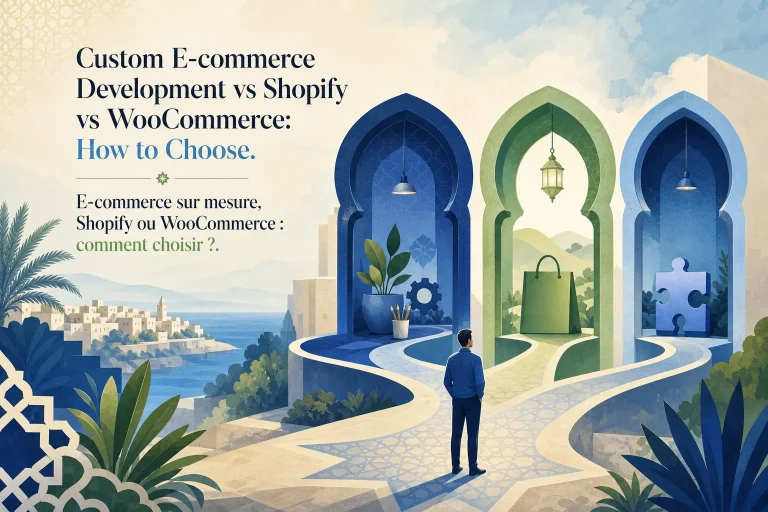
Should your organization commission custom software or adopt an existing product? Our recommendation is to start with the business capability, not a preference for building or buying: evaluate ready-made products for common needs, reserve custom development for valuable differences, and consider a hybrid where the boundary is clear.
The decision should answer three questions: what must the software accomplish, what will it require throughout its life, and who will remain accountable after launch?
When does each option make sense?
Off-the-shelf software is an existing product adopted by multiple customers. Custom software is developed for specific requirements. Neither choice determines whether the application must run in the cloud or on your own infrastructure.
The UK Government Digital Service’s purchasing guidance offers a useful distinction: buying suits needs that available products can meet, while building deserves consideration when essential requirements cannot be adequately served, integrated or adapted. This is public-sector guidance, not a universal business obligation.
Buy when the standard process is good enough
Our suggested starting point: test an existing product when you can accept its core workflow without sacrificing a meaningful business advantage. For example, ask whether your internal meeting-booking process genuinely warrants proprietary software.
Build when a specific difference earns its investment
Consider custom development when you can explain the value of the unmet requirement. In a hypothetical distribution business, a distinctive allocation process might justify a tailored application. But “our process is different” is not enough: identify the customer outcome, operational improvement or strategic capability that makes preserving it worthwhile.
Combine the two when responsibilities stay clear
A possible hybrid is an existing customer-management product connected to a custom customer portal. Treat that as an architecture to validate, not an automatic compromise. Specify which system owns each record, how updates move between systems, and who resolves failed exchanges.
Do not confuse configuration with extensive product modification. The Government Digital Service’s build-or-buy analysis highlights the lifecycle consequences of customization and favors configuration where appropriate. It also stresses that buying or outsourcing does not remove the need for internal oversight.
Compare lifetime cost—not a quote against a subscription
Salesforce’s Resource and Cost Optimization guidance includes implementation, operations, maintenance, integration and organizational effort in total cost of ownership. Although platform-specific, that accounting principle is useful for this comparison.
For your decision, request comparable estimates covering:
- Getting started: discovery, configuration or development, migration, testing and training.
- Running the solution: licenses, hosting, support, administration and security maintenance.
- Changing and leaving: enhancements, integration updates, data export and replacement work.
Use the same planning period and workload assumptions for every option. Then test your own scenarios: more users, higher transaction volumes, an additional country or a supplier change. Compare expected benefits separately from costs; an inexpensive system that misses the essential outcome should not win by default.
Make security and exit options selection criteria
Request evidence of ongoing security work
Rather than treating either delivery model as proof of security, ask how security is implemented and maintained. NIST’s Secure Software Development Framework, Version 1.1 provides practices for incorporating security into development and a common vocabulary for discussions between purchasers and suppliers.
Ask who handles vulnerability reports, component updates, incident communication and the end of support. These are concrete themes in the UK’s voluntary Software Security Code of Practice. Request supporting processes and contractual commitments rather than accepting a generic “secure” label.
Test whether you can move—not just whether you can export
The Government Digital Service’s open-standards guidance connects interoperability with flexibility and reduced supplier dependence. Our practical recommendation is to demonstrate an export and inspect whether relationships, attachments and relevant history remain usable.
For custom work, ask for explicit agreement on code ownership, third-party licensing, repository access, documentation and handover. For purchased software, examine API access, export restrictions and transition assistance. Do not assume either model guarantees independence.
Run a decision process that exposes the difficult parts
The Technology Code of Practice starts with user needs and includes accessibility, integration and lifecycle considerations. Building on those principles, we suggest this evaluation sequence:
- Define the outcome: choose a measurable target, such as fewer manual corrections or a shorter approval cycle.
- Separate essentials from preferences: identify requirements whose absence would disqualify a solution.
- Test a difficult workflow: include an exception, an integration and representative data—not only a polished demonstration.
- Validate international use: check required languages, accessibility, currencies, time zones, hosting constraints and support coverage for each intended market.
- Record the decision: document assumptions, unresolved risks, acceptance criteria and the owner of ongoing operations.
Choose the delivery relationship as carefully as the software
For a custom project, consider whether an internal team, an external development partner or team augmentation best matches your available leadership and expertise. Our recommendation is to name an internal business owner in every model and agree who prioritizes work, accepts releases and funds maintenance.
Potential strategic partners should examine responsibilities at integration boundaries and during handover. Investors assessing a software-dependent business can use the same questions to examine technical dependence and recurring obligations; proprietary code alone should not be treated as evidence of business value.
Altweeb’s technology consulting, software and digital product development, and IT staffing and team augmentation services are relevant to these choices. A useful starting conversation is about the unmet business need, existing systems and available delivery capacity—not a predetermined commitment to custom development.
The bottom line
Choose the option that meets essential needs with an acceptable lifetime commitment. Buy where the product fits, build where a valuable requirement justifies it, and combine approaches only when you can manage the connections. Before committing, require a realistic workflow test, comparable cost assumptions and a credible ownership and exit plan.
To explore this further, see Digital products built around specific needs..
Sources and further reading
- The Technology Code of Practice
- Define your purchasing strategy
- To build or to buy – that’s the technology question
- Software Security Code of Practice
- Secure Software Development Framework (SSDF) Version 1.1: Recommendations for Mitigating the Risk of Software Vulnerabilities
- Resource and Cost Optimization


Add your perspective